kapa kulture

This blog is dedicated to Hawaiian kapa and matters related to Hawai'i nei…kuku kapa e!

Archive for the tag “cultural arts”

The Legend of the Kua Kapa

The Legend of the Kua Kapa
From “Nā Mo’olelo Hawai’i o ka Wā Kahiko, Stories of Old Hawai’i” By Roy Kākulu Alameida, Bess Press, Honolulu, 1997.

One day Kalei, who lived in Kahuku on O’ahu, could not find her kua kapa. She looked all over the hale, but it was nowhere to be seen. She asked her neighbors if they had seen it. No one had. She began to feel very sad because it was her favorite kua kapa.

Kalei walked through the village. She listened for her kua kapa. Each kua kapa gave a sound of its own that was either a high or low sound. Her kua kapa made a sound that only she could recognize. She heard others, but they were not hers. She walked to Maunalua, then to Manoa. She still could not find her kua kapa. After reaching Kapalama, she stopped to rest under a lama tree. She had been traveling all day and all night and she was very tired.

Soon Kalei was sound asleep. While she slept, a gentle breeze wafted over her. It carried a faint sound. She woke up with a start and listened carefully. Again, the gentle breeze wafted from ma uka. It carried a familiar sound through the valley to where she sat. “That sounds like my kua kapa,” Kalei said to herself. So Kalei started to walk in the direction of the sound. As she walked toward Līhu’e, near Ka’ala the sound got louder and louder. It sounded so sweet that tears began to roll down her cheeks. At last she would hold her favorite kua kapa again.

The woman who was using the kua kapa lived in Keanapueo, or owl’s cave, near Waikele. Kalei walked along the stream until she reached the cave. “That sounds like my kua kapa,” Kalei told the woman. “How did you get it?” She asked.

“I found it floating in the stream that comes from the mountain,” said the woman.

“It belongs to me. I recognize the sound,” said Kalei.

The woman gave back the kua kapa. But she was not convince that it belonged to Kalei. To see if Kalei was telling the truth, the woman followed her to Kahuku. When they reached there, the woman tied a bundle of ti leaves together. She tossed it into the stream at Pu’uho’olapa. After it floated downstream and disappeared, the woman returned to her home at Keanapueo. A few days later, she saw the bundle of ti leaves floating in the stream near her home. This proved to her that Kalei was the true owner of the kua kapa.

Glossary of Hawaiian Words

kua kapa: tapa-beating anvil

kapa: tapa (bark cloth)

hale: house

lama: hardwood tree

ma uka: toward the mountain

kua kapa o milo
kua kapa o milo

Hawaiian Word of the day: hālu’a

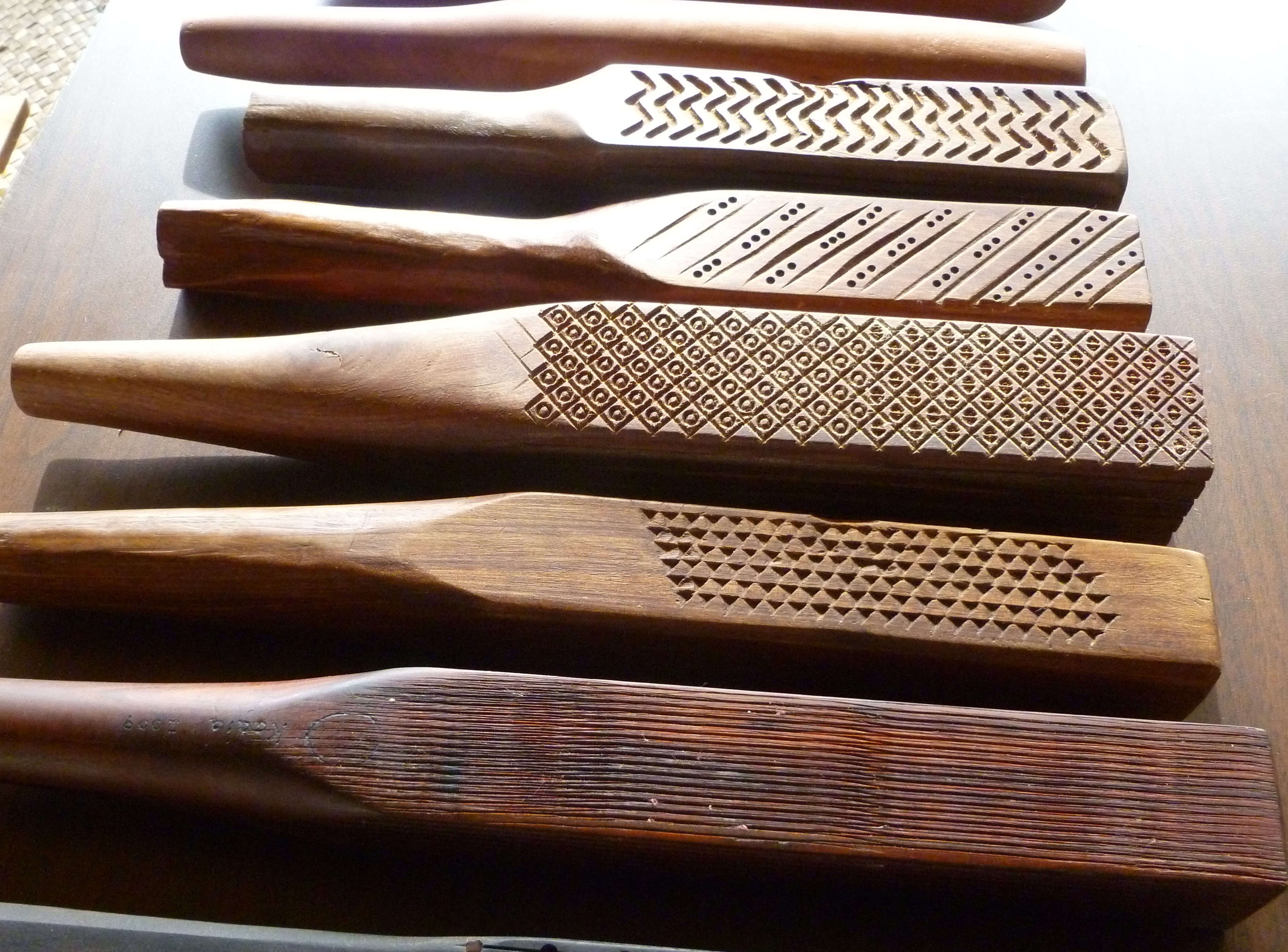
hālu’a: 1. stripe, ripple; ridged seamed, streaked, wrinkled. ‘ālu’a. 2. Pattern on the surface of a tapa beater or tapa. This term may follow types of beaters, as ko’eau hālu’a, mole hālua, pū’ili halu’a. It also precedes types of beaters, as listed below. 3. Variation of hānu’a (thick).

hālu’a ko’eau: Design on a tapa beater consisting of one or more straight lines separating every two wavy lines. Gently waving, delicate parallel lines (the waves are smaller and less jagged than those of the ha’ao.

hālu’a lei hala: Tapa beater design said to resemble pandanus lei and consisting of interlocked triangles.

hālu’a maka ‘upena: Tapa-beater design resembling net mesh.

hālu’a mana mana: Tapa-beater design. Branch, limb; a line projecting from another line, forked.

hālu’a niho manō: The panels between the hālu’a lines are enhanced by regularly spaced small triangles. Lit., shark tooth hālu’a.

hālu’a pāwehe niho manō: Tapa-beater design. The triangles of the niho manō pattern are bordered by oblique lines (pāwehe).

hālu’a pu’ili: A tapa-beater design pattern: tips of zigzag ridges in adjacent surfaces meet and form sunken lozenges. (ko’eau, in which the ridges are parallel).

hālu’a pūpū: A tapa-beater pattern with circular motifs (pūpū), also kōnane pūpū. (pūpū: 1. general name for marine and land shells; beads, snail. 2. any circular motif as in tapa, kōnane pūpū, checkerboard pattern [with rounded pits on each square, as on tapa].

(Hawaiian Dictionary,Revised and Enlarged Edition. Pukui & Elbert, 1971).

P1020871

Hawaiian Word of the Day: ola

ola: Life, health, well-being, living, livelihood, means of support, salvation; alive, living, curable, spared, recovered; healed; to live, to spare, save, heal, grant life, survive, thrive. Ola loa, long life, longevity. Ola ‘ana, life, existence. Mālama ola, financial support, means of livelihood. Nā kālā no ke ola o ka nūpepa, money for the support of the newspaper. ‘O nā lā apau o kona ola ‘ana, all the days of his life. Makamaka ola, a live friendship; a friend who extends hospitality and appreciation. I ola ‘ole nei keiki, this (beloved) child did not survive. Ua loa’a ke kāne a ku’u hānai, a ua ola nā iwi o ke kahu hānai, my foster child has found a husband, and the foster parent will enjoy peace and comfort in life and the body will be preserved after death; lit., the bones will live, i.e., the will not fall into an enemy’s hands. Ola ka inoa, the name lives on, said of a child bearing the name of an ancestor. Ola ka pōloli, hunger is satisfied. Ola ka mō’i i ke Akua, God save the king. E ola au i ke Akua, may God grant me life; so help me God. E ola au īa oe, save me, spare my life. ho.ōla. To save, heal, cure, spare; salvation; healer; savior. Po’e i kū’ai ho’ōla ‘īa, ransomed people.

-ola. ho’ōla: Small piece of tapa; tapa in general (Kaua’i). (Pukui & Elbert, 1971).

How Kapa Was Made

From Na Mo’olelo Hawai’i o ka Wa Kahiko, Stories of Old Hawai’i, How Kapa Was Made, p. 66-67. by Roy Kakulu Alameida (1997), Bess Press, Honolulu

How Kapa Was Made
After he died, Maikoha became the ‘aumakua of all kapa makers. Wauke branches were planted on all the islands. Prayers and sacrifices were offered to Maikoha. Soon each of his daughters also became an ‘aumakua. Lauhu’iki became the ‘aumakua of all the women who pounded the prepared bark from the wauke. She was given the power of finding kapa in the bark of the tree. She also had the power of teaching others how to pound the bark correctly. She taught them how to care for those who worshiped her. The other daughter, La’ahana, was worshiped by those who used special kapa ku’i that made marks and patterns on the kapa. Thus, Maikoha and his daughters were the main ‘aumakua of all kapa makers. But the other gods from time to time found new ways to use the wauke.

One was ‘Ehu. He learned and taught others how to dip kapa into dyes to give it color. He discovered that a red dye can be made from the kukui tree. Prayers and food were offered to him while the dyes were being collected and when the kapa maker wanted to add color to the kapa. There were kapa of different colors and designs. Sometimes kapa were spotted by sprinkling colors over them. Sometimes torn-up pieces of kapa were pounded together with new kapa to produce a spotted look. Sometimes bamboo was used to draw lines and figures. White kapa were used in the heiau to cover the images. When kapa was laid on an object, it meant that the object was not to be touched. Anyone who removed the kapa would be punished by the ‘aumakua. When kapa was hung on a pole and placed on a trail, it meant that the trail was kapu. A kapa dipped in black dye was kept for covering the body of an ali’i who had died.

Sometimes the sweet-smelling flowers or the oil from the ‘iliahi tree were pounded into the kapa. Flowers from the niu and hala and other sweet-smelling plants were placed in hot water. This made perfume. When the kapa was perfumed, it was dried inside a house. That way the smell would not be lost.

Sometimes kapa were well scraped with pieces of shell or rubbed with stones. Then they were rolled in dirt and placed in a calabash. They were soaked in water for a long time. After they were washed and pounded again, the kapa became very soft. Often kapa were spread out over cold, wet freshwater moss overnight. This made kapa very bright and shining. Spider eggs were often used to oil the kapa.

Hina, the mother of Maui, was a great kapa maker. Her kapa is spread all over the sky. These are the beautiful clouds of all colors. Sometimes they are piled on top of each other. Sometimes they are lying in sheets. Sometimes the strong winds blow and lift and toss the kapa. The winds blow off the stones Hina placed on the kapa to hold them down. Sometimes Hina throws off the stones herself. The noise of the rolling stones sounds like thunder. Sometimes Hina rolls the cloud sheets together. The folds flash in the light of the sun like lightning.

Glossary of Hawaiian Words

‘aumakua: family god (singular or plural form)

wauke: paper mulberry tree (Brousonetia papyrifera) its bark was pounded to make cloth

kapa: tapa (bark cloth)

kapa ku’i: tapa beater

kukui: candlenut tree (Aleurites moluccana)

heiau: temple

kapu: forbidden; sacred

ali’i: chief

‘iliahi: sandalwood (Santulum paniculatum)

niu: coconut (Cocos nucifera)

hala: pandanus tree (Pandanus utilis)

Hawaiian Word of the Day: kilohana

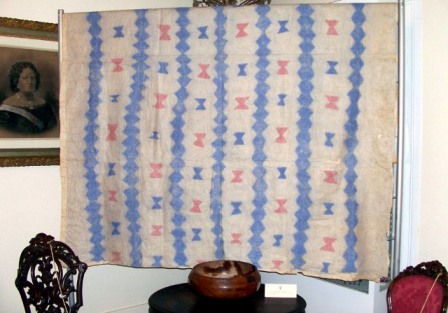
kilohana: name of the outside, decorated sheet of tapa in the ku’inakapa, bed coverings; the four inner layers were white, contrasting with the decorated kilohana. Hence extended meanings: best, superior, excellent. He ali’i ke aloha, he kilohana e pa’a ai (saying), love is like a chief, the best prize to hold fast to. 2. Hillock, heap, lookout, top, view out, high point (kilo + -hana, nominalizer). (Probably Proto-Polynesian tirofanga; Tongan siofi, siofia and Samoan tilofia.) (Pukui & Elbert, 1971).

This kilohana of kapa moe is at the San Diego Museum of Art

This kilohana of kapa moe is at the San Diego Museum of Art

This kilohana is displayed at Queen Emma's Summer Palace, Honolulu

This kilohana is displayed at Queen Emma’s Summer Palace, Honolulu

2013, New Year, New Beginnings

My goal in starting this blog is to learn all I can about Hawaiian kapa. From tools to processes, from designs to pigments and dyes… I hope to create a repository for my research and a journal that documents my journey. I hope that the knowledge shared here is of interest to others. Perhaps more importantly, I expect to be transformed as a person, as an artist, and as a Hawaiian… as my identity embraces the mana’o of my ancestors….

Post Navigation