Hawaiian Word of the Day: makakilo
makakilo: Observant, watchful eyes; to watch with great attention (Pukui & Elbert, 1971).

makakilo: Observant, watchful eyes; to watch with great attention (Pukui & Elbert, 1971).
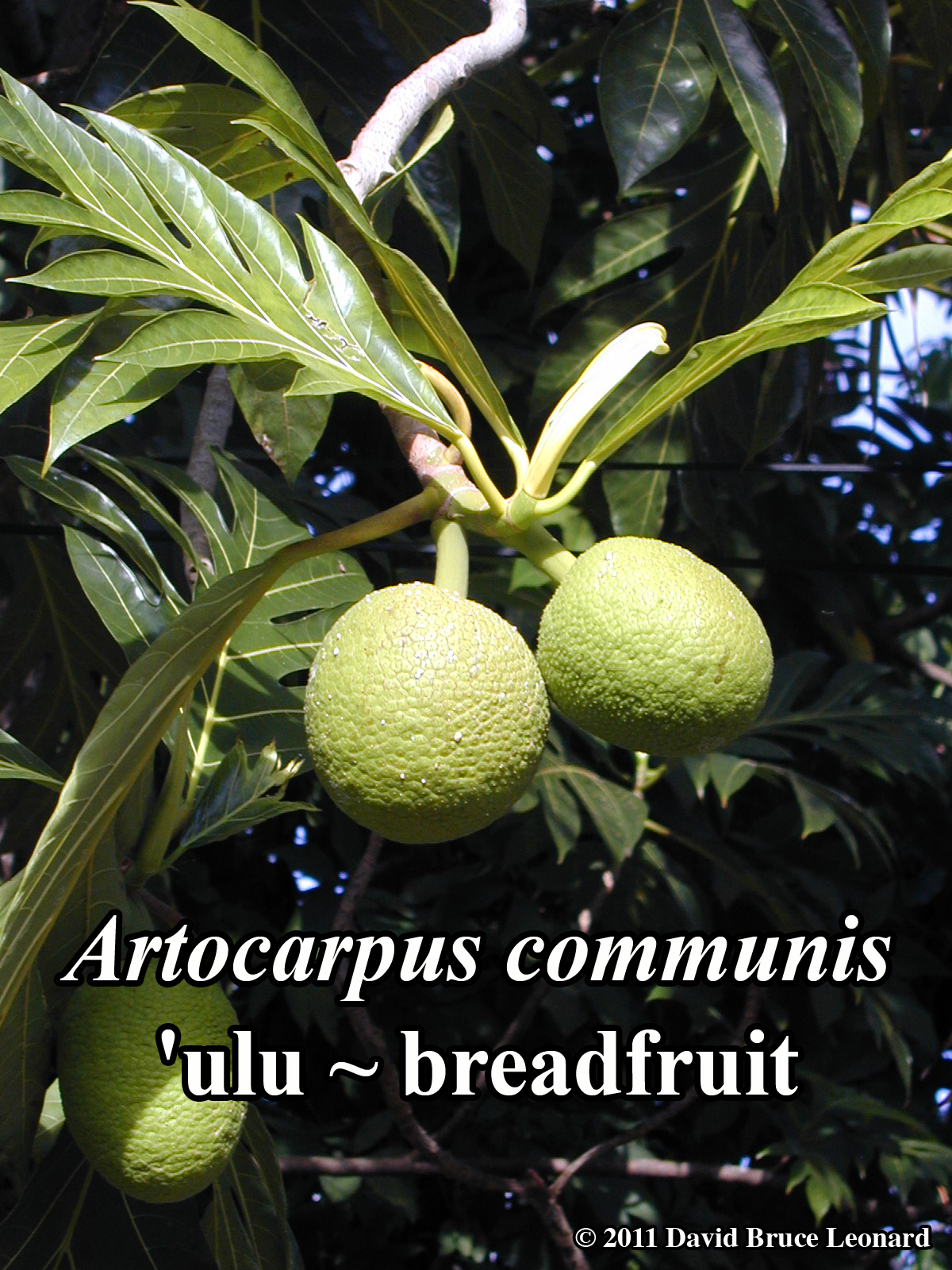
pō’ulu: Bark of tender breadfruit shoots, as used for less fine tapa (Pukui & Elbert, 1971).
Throughout the South Pacific islands, each island nation has its own particular nuances in making tapa cloth, which distinguishes it from another. Traditional techniques were passed down and were a life skill in the community. Making tapa cloth was done primarily by women. It is a women’s art that has changed only slightly since ancient times.
Generally speaking, in Western Polynesia a piece of tapa was produced by pasting sheets together in layers and then joining smaller pieces by pasting to make a larger cloth. A heavy, coarse material results from this method. Whereas in Eastern Polynesia a felting process was done, pounding pieces into a single layer, without a fusing agent, or paste. Gradually a large piece of cloth is built up using this felting process. And a softer product is the result.
The tapa cloth in Polynesia begins with a basic process of removing the inner bark, or bast, from the trees and soaking this inner part in water for several days to soften and ferment the fibers and get them ready for pounding into thin sheets. The paper mulberry trees (wauke) are grown for this purpose and carefully cultivated. They are allowed to grow six to eight feet high until one to two inches in diameter. The trees are constantly cared for and tended while they grow. Young branches are broken off to ensure consistent, straight fibers to make smooth, whole tapa sheets unmarred by holes.
Special tools are used in the fabrication of tapa cloth. A type of anvil, a wooden block usually, is a sort of table that the bark is placed on and from start to finish, the tapa is pounded, or beaten. Techniques involve special shells used like knives to strip off the outer bark lengthwise from the tree, and to remove the bast. A selection of carved, wooden beaters flattens and spreads the fibers. Starting with a rounded club, moving to a grooved style that has four parallel sides, serving as steps toward finishing a smooth final product.
Additionally, Hawaiian tapa, or kapa cloth has a final step of beating, which leaves a watermark imprint on the cloth. This watermark is a unique carved design on a beater that served as the artist’s signature and finished the work in an important part of the felting process.
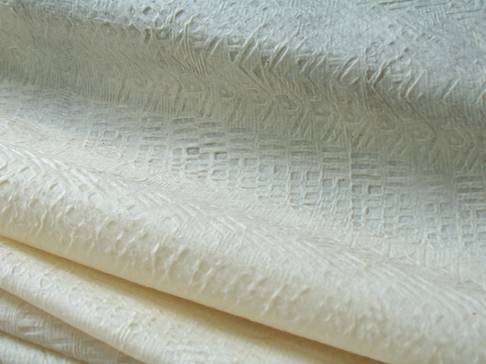
Kapa with watermark, made by Dalani Tanahy
maoli: Native, indigenous, aborigine, genuine, true, real, actual; very, really, truly. Maika’i maoli, very good indeed. Kanaka maoli, ‘ōlelo maoli, Hawaiian native, Hawaiian language [so used in reports of 1852 legislative session]. E puka ai ka makemake maoli o ka mea koho, expressing the free will of the voter.
The Legend of the Kua Kapa
From “Nā Mo’olelo Hawai’i o ka Wā Kahiko, Stories of Old Hawai’i” By Roy Kākulu Alameida, Bess Press, Honolulu, 1997.
One day Kalei, who lived in Kahuku on O’ahu, could not find her kua kapa. She looked all over the hale, but it was nowhere to be seen. She asked her neighbors if they had seen it. No one had. She began to feel very sad because it was her favorite kua kapa.
Kalei walked through the village. She listened for her kua kapa. Each kua kapa gave a sound of its own that was either a high or low sound. Her kua kapa made a sound that only she could recognize. She heard others, but they were not hers. She walked to Maunalua, then to Manoa. She still could not find her kua kapa. After reaching Kapalama, she stopped to rest under a lama tree. She had been traveling all day and all night and she was very tired.
Soon Kalei was sound asleep. While she slept, a gentle breeze wafted over her. It carried a faint sound. She woke up with a start and listened carefully. Again, the gentle breeze wafted from ma uka. It carried a familiar sound through the valley to where she sat. “That sounds like my kua kapa,” Kalei said to herself. So Kalei started to walk in the direction of the sound. As she walked toward Līhu’e, near Ka’ala the sound got louder and louder. It sounded so sweet that tears began to roll down her cheeks. At last she would hold her favorite kua kapa again.
The woman who was using the kua kapa lived in Keanapueo, or owl’s cave, near Waikele. Kalei walked along the stream until she reached the cave. “That sounds like my kua kapa,” Kalei told the woman. “How did you get it?” She asked.
“I found it floating in the stream that comes from the mountain,” said the woman.
“It belongs to me. I recognize the sound,” said Kalei.
The woman gave back the kua kapa. But she was not convince that it belonged to Kalei. To see if Kalei was telling the truth, the woman followed her to Kahuku. When they reached there, the woman tied a bundle of ti leaves together. She tossed it into the stream at Pu’uho’olapa. After it floated downstream and disappeared, the woman returned to her home at Keanapueo. A few days later, she saw the bundle of ti leaves floating in the stream near her home. This proved to her that Kalei was the true owner of the kua kapa.
Glossary of Hawaiian Words
kua kapa: tapa-beating anvil
kapa: tapa (bark cloth)
hale: house
lama: hardwood tree
ma uka: toward the mountain

kua kapa o milo
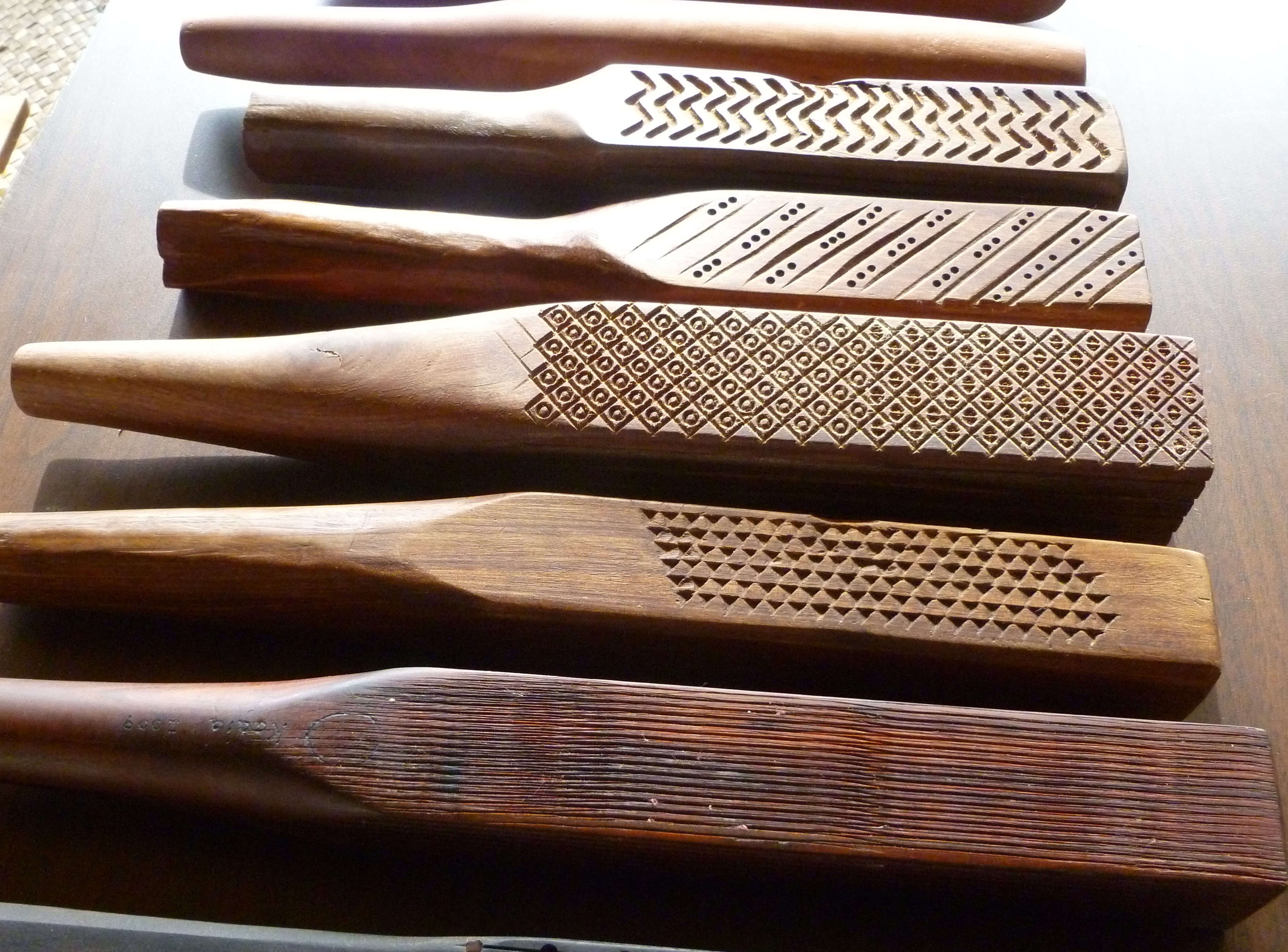
hālu’a: 1. stripe, ripple; ridged seamed, streaked, wrinkled. ‘ālu’a. 2. Pattern on the surface of a tapa beater or tapa. This term may follow types of beaters, as ko’eau hālu’a, mole hālua, pū’ili halu’a. It also precedes types of beaters, as listed below. 3. Variation of hānu’a (thick).
hālu’a ko’eau: Design on a tapa beater consisting of one or more straight lines separating every two wavy lines. Gently waving, delicate parallel lines (the waves are smaller and less jagged than those of the ha’ao.
hālu’a lei hala: Tapa beater design said to resemble pandanus lei and consisting of interlocked triangles.
hālu’a maka ‘upena: Tapa-beater design resembling net mesh.
hālu’a mana mana: Tapa-beater design. Branch, limb; a line projecting from another line, forked.
hālu’a niho manō: The panels between the hālu’a lines are enhanced by regularly spaced small triangles. Lit., shark tooth hālu’a.
hālu’a pāwehe niho manō: Tapa-beater design. The triangles of the niho manō pattern are bordered by oblique lines (pāwehe).
hālu’a pu’ili: A tapa-beater design pattern: tips of zigzag ridges in adjacent surfaces meet and form sunken lozenges. (ko’eau, in which the ridges are parallel).
hālu’a pūpū: A tapa-beater pattern with circular motifs (pūpū), also kōnane pūpū. (pūpū: 1. general name for marine and land shells; beads, snail. 2. any circular motif as in tapa, kōnane pūpū, checkerboard pattern [with rounded pits on each square, as on tapa].
(Hawaiian Dictionary,Revised and Enlarged Edition. Pukui & Elbert, 1971).
Linguistic origin of the Hawaiian language can be traced through genealogy chants, indicating family ties to the South Pacific islands of Polynesia and beyond. Words have similarities in sound and meaning. For example, one general rule is that in South Pacific Polynesia, the /r/ and /t/ sounds substitute for /l/ and /k/, as in the words kapa, kalo, and moku of Hawai’i and tapa, taro, and motu of Tahiti. An exception to this rule is found in Ni’ihau, where a soft /t/ sound is predominantly used in place of the /k/. The /k/ used in song, prayer and other specific occasions.
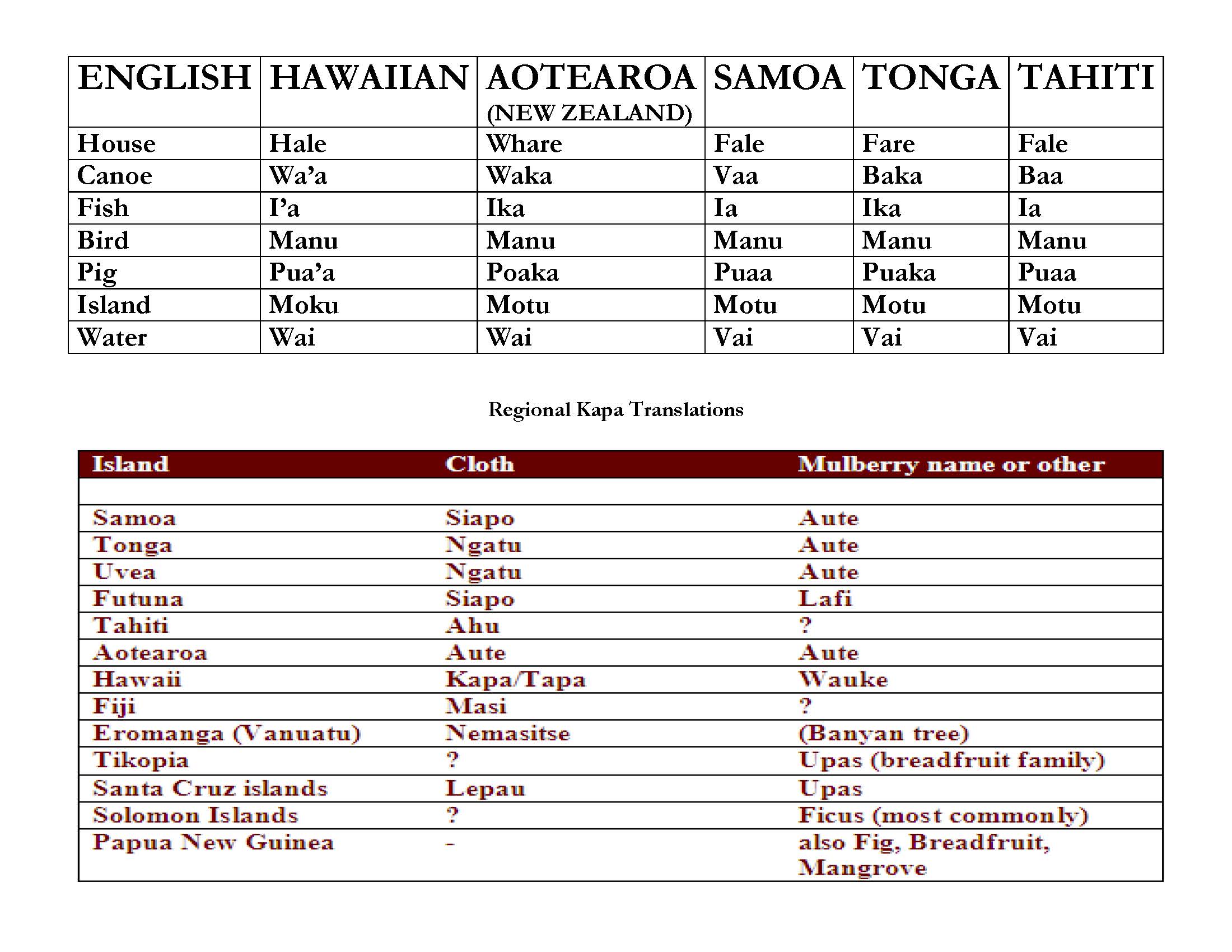
lāhui: 1. Nation, race, tribe, people, nationality; great company of people; species, as of animal or fish, breed; national, racial. Lāhui kaua, a warring people; a large company of soldiers (rare). ‘Ao’ao Lepupalika lāhui, national Republican Party. Lāhui ‘ae’a, nomadic people, gypsy. Lāhui pua o lalo, commoner. ho’olāhui: To form a nation, race, etc. 2. To assemble, gather together. 3. To prohibit, forbid, lay a taboo, proclaim a law (Samoan, lafu: to prohibit). Lāhui ‘ia ka wala’au e Pele, loud talk was prohibited by Pele. ho’olāhui: To cause to be consecrated; to taboo. (Proto Nuclear Polynesian: lafu; Proto Central Polynesian: laafui).
lāhui huipū: United nation. Na Lāhui Huipu, United Nations.
lāhui kanaka: Nation, people, tribe, multitude; mankind, humanity.
māla: Garden, plantation, patch, cultivated field, as māla ‘ai, taro patch, food garden or plantation; or māla wauke, cultivated garden of wauke for the purpose of kapa making. (Pukui & Elbert, 1971).


