Hawaiian Word of the Day: lōkahi
lōkahi: Unity, agreement, accord, unison, harmony; agreed, in unity. Mana’o lōkahi, unanimous. ho’olōkahi: To bring about unity; to make peace and unity; to be in agreement (Pukui & Elbert, 1971).

lāhui: 1. Nation, race, tribe, people, nationality; great company of people; species, as of animal or fish, breed; national, racial. Lāhui kaua, a warring people; a large company of soldiers (rare). ‘Ao’ao Lepupalika lāhui, national Republican Party. Lāhui ‘ae’a, nomadic people, gypsy. Lāhui pua o lalo, commoner. ho’olāhui: To form a nation, race, etc. 2. To assemble, gather together. 3. To prohibit, forbid, lay a taboo, proclaim a law (Samoan, lafu: to prohibit). Lāhui ‘ia ka wala’au e Pele, loud talk was prohibited by Pele. ho’olāhui: To cause to be consecrated; to taboo. (Proto Nuclear Polynesian: lafu; Proto Central Polynesian: laafui).
lāhui huipū: United nation. Na Lāhui Huipu, United Nations.
lāhui kanaka: Nation, people, tribe, multitude; mankind, humanity.
pōmaika’i: Good fortune, blessedness, blessing, profit, prosperity; prosperous, fortunate, beneficial, blessed, lucky; good luck, improvement (of property), welfare, benefits. Pōmaika’i au, blessed am I. He pōmaika’i ‘ia mai ke Akua, a blessing from God. E pili mau nā pōmaika’i me ‘oe, may you always have good fortune [a way to say best wishes] Ho’o.pō.mai.ka’i: To cause good fortune; to bless, improve, ask grace; blessing (Pukui & Elbert, 1971).
ola: Life, health, well-being, living, livelihood, means of support, salvation; alive, living, curable, spared, recovered; healed; to live, to spare, save, heal, grant life, survive, thrive. Ola loa, long life, longevity. Ola ‘ana, life, existence. Mālama ola, financial support, means of livelihood. Nā kālā no ke ola o ka nūpepa, money for the support of the newspaper. ‘O nā lā apau o kona ola ‘ana, all the days of his life. Makamaka ola, a live friendship; a friend who extends hospitality and appreciation. I ola ‘ole nei keiki, this (beloved) child did not survive. Ua loa’a ke kāne a ku’u hānai, a ua ola nā iwi o ke kahu hānai, my foster child has found a husband, and the foster parent will enjoy peace and comfort in life and the body will be preserved after death; lit., the bones will live, i.e., the will not fall into an enemy’s hands. Ola ka inoa, the name lives on, said of a child bearing the name of an ancestor. Ola ka pōloli, hunger is satisfied. Ola ka mō’i i ke Akua, God save the king. E ola au i ke Akua, may God grant me life; so help me God. E ola au īa oe, save me, spare my life. ho.ōla. To save, heal, cure, spare; salvation; healer; savior. Po’e i kū’ai ho’ōla ‘īa, ransomed people.
-ola. ho’ōla: Small piece of tapa; tapa in general (Kaua’i). (Pukui & Elbert, 1971).
māla: Garden, plantation, patch, cultivated field, as māla ‘ai, taro patch, food garden or plantation; or māla wauke, cultivated garden of wauke for the purpose of kapa making. (Pukui & Elbert, 1971).

huaka’i : Trip, voyage, journey, mission, procession, parade; to travel, parade. ka’i, to lead. (Pukui & Elbert, 1971)
kilohana: name of the outside, decorated sheet of tapa in the ku’inakapa, bed coverings; the four inner layers were white, contrasting with the decorated kilohana. Hence extended meanings: best, superior, excellent. He ali’i ke aloha, he kilohana e pa’a ai (saying), love is like a chief, the best prize to hold fast to. 2. Hillock, heap, lookout, top, view out, high point (kilo + -hana, nominalizer). (Probably Proto-Polynesian tirofanga; Tongan siofi, siofia and Samoan tilofia.) (Pukui & Elbert, 1971).

This kilohana of kapa moe is at the San Diego Museum of Art
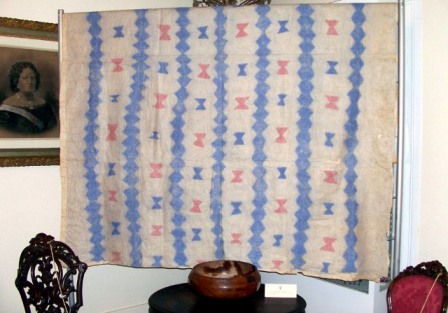
This kilohana is displayed at Queen Emma’s Summer Palace, Honolulu
ea: 1. Sovereignty, rule, independence. La Ho’iho’i Ea, Restoration Day. Ho’iho’i i ke ea o Hawai’i, restore the sovereignty of Hawai’i. 2. Life, air, breath, respiration, vapor, gas; fumes, as of tobacco; breeze, spirit. This ea, as well as ea 1,3,4, is sometimes pronounced or sung ‘ea. eamama, eaolamama. Kaha ea, to deprive of rights of livelihood. Wai ea, aerated waters. Ho’opuka ea, exhaust fumes. Ua mau ke ea o ka ‘aina i ka pono (the motto of Hawai’i), the life of the land is perpetuated in righteousness. 3. To rise, go up, raise, become erect. aea, e’ea, ho’ea. Kai ea, rising sea. Ua ea kona po’o, his head was raised. 4. To smell. (Pukui & Elbert, 1971).

e ala e

