kapa kulture

This blog is dedicated to Hawaiian kapa and matters related to Hawai'i nei…kuku kapa e!

Archive for the category “Mo’olelo (stories)”

How Kapa Was Made

From Na Mo’olelo Hawai’i o ka Wa Kahiko, Stories of Old Hawai’i, How Kapa Was Made, p. 66-67. by Roy Kakulu Alameida (1997), Bess Press, Honolulu

How Kapa Was Made
After he died, Maikoha became the ‘aumakua of all kapa makers. Wauke branches were planted on all the islands. Prayers and sacrifices were offered to Maikoha. Soon each of his daughters also became an ‘aumakua. Lauhu’iki became the ‘aumakua of all the women who pounded the prepared bark from the wauke. She was given the power of finding kapa in the bark of the tree. She also had the power of teaching others how to pound the bark correctly. She taught them how to care for those who worshiped her. The other daughter, La’ahana, was worshiped by those who used special kapa ku’i that made marks and patterns on the kapa. Thus, Maikoha and his daughters were the main ‘aumakua of all kapa makers. But the other gods from time to time found new ways to use the wauke.

One was ‘Ehu. He learned and taught others how to dip kapa into dyes to give it color. He discovered that a red dye can be made from the kukui tree. Prayers and food were offered to him while the dyes were being collected and when the kapa maker wanted to add color to the kapa. There were kapa of different colors and designs. Sometimes kapa were spotted by sprinkling colors over them. Sometimes torn-up pieces of kapa were pounded together with new kapa to produce a spotted look. Sometimes bamboo was used to draw lines and figures. White kapa were used in the heiau to cover the images. When kapa was laid on an object, it meant that the object was not to be touched. Anyone who removed the kapa would be punished by the ‘aumakua. When kapa was hung on a pole and placed on a trail, it meant that the trail was kapu. A kapa dipped in black dye was kept for covering the body of an ali’i who had died.

Sometimes the sweet-smelling flowers or the oil from the ‘iliahi tree were pounded into the kapa. Flowers from the niu and hala and other sweet-smelling plants were placed in hot water. This made perfume. When the kapa was perfumed, it was dried inside a house. That way the smell would not be lost.

Sometimes kapa were well scraped with pieces of shell or rubbed with stones. Then they were rolled in dirt and placed in a calabash. They were soaked in water for a long time. After they were washed and pounded again, the kapa became very soft. Often kapa were spread out over cold, wet freshwater moss overnight. This made kapa very bright and shining. Spider eggs were often used to oil the kapa.

Hina, the mother of Maui, was a great kapa maker. Her kapa is spread all over the sky. These are the beautiful clouds of all colors. Sometimes they are piled on top of each other. Sometimes they are lying in sheets. Sometimes the strong winds blow and lift and toss the kapa. The winds blow off the stones Hina placed on the kapa to hold them down. Sometimes Hina throws off the stones herself. The noise of the rolling stones sounds like thunder. Sometimes Hina rolls the cloud sheets together. The folds flash in the light of the sun like lightning.

Glossary of Hawaiian Words

‘aumakua: family god (singular or plural form)

wauke: paper mulberry tree (Brousonetia papyrifera) its bark was pounded to make cloth

kapa: tapa (bark cloth)

kapa ku’i: tapa beater

kukui: candlenut tree (Aleurites moluccana)

heiau: temple

kapu: forbidden; sacred

ali’i: chief

‘iliahi: sandalwood (Santulum paniculatum)

niu: coconut (Cocos nucifera)

hala: pandanus tree (Pandanus utilis)
The Legend of the Wauke Tree

From the book, Na Mo’olelo Hawai’i o ka Wa Kahiko, Stories of Old Hawai’i
by Roy Kakulu Almeida (1997) Bess Press, Honolulu.

The Legend of the Wauke Tree
Maikoha lived with his family at Puiwa. This place was in the cool and green valley of Nu’uanu, on O’ahu. He worked hard every day in the lo’i near his home. He grew enough food to care for his family, pay the annual taxes during Makahiki, and provide the family ho’okupu to the gods.

He had two daughters, Lauhuiki and La’ahana. He loved them very much. He wanted them to be warm. He did not want them to suffer from the chilly winds and rain that often swept through the valley.

Maikoha was getting older. His body was not healthy and strong enough to withstand the cold winds. As he became older and weaker, Maikoha knew that he would die soon. One day he called his daughters to him. He told them that when he died they should secretly bury him near the cool, clear waters of the stream that flowed by their home.

Then Maikoha said to them, “Watch for a tree that will grow from that place. That tree,” he said, “will be my own body growing into a useful tree. You will call it wauke.”

“But how will we know how to use the tree?” asked Lauhuiki.

Maikoha continued, “When the tree is grown, cut the stems of the tree. Strip off the bark. Then pound and pound the stems with a kua kapa until the bark fibers cling to each other like cloth.”

After he gave his instructions, Maikoha lay down to rest. Soon he died. His daughters did as they were told. They buried him in a sunny area near the stream. Every day they cleaned the area and placed a fresh maile lei on the grave.

A few days after they buried their father, a tree began to grow straight and tall from the grave just as their father had said it would. Each day as they watched the tree grow, it spread out many new branches. They named it wauke as their father had told them to do. “It’s time to do what father said,” Lauhiki told her sister.

While asking their father for guidance, they carefully cut the stems off the tree. They stripped off the bark and soaked the branches in water. Then they began to pound and pound the bark until the fibers began to cling to each other like cloth. As they did each step of the process, Maikoha guided their hands. They recognized that their father was their own ‘aumakua.

This was how they learned to make kapa. They made the malo and the pa’u for clothing. These kept them warm and comfortable when the cold winds blew through the valley.

The wauke tree spread throughout Nu’uanu Valley and toher parts of O’ahu and the other islands. Whenever a branch was broken off the tree and stuck in the ground, it would grow. This way the spirit of Maikoha continues to live on all the islands.

Glossary of Hawaiian Words

lo’i: taro or kalo patch

makahiki: ancient festival that lasted for a season of about four months, celebrated by sports and a taboo on war

ho’okupu: gift, offering

wauke: paper mulberry; its bark was used to make tapa or kapa

kua kapa: tapa beating anvil

maile: native Hawaiian twining shrub with a pleasant fragrance

‘aumakua: family god or guardian

kapa: tapa (bark cloth

malo: loincloth

pa’u: skirt

Kanu e ka mala wauke. (Plant the wauke garden.)

Kanu e ka mala wauke. (Plant the wauke garden.)

Archaeology of the Tapa

When I began my research into tapa cloth, I found that this form of beaten bark cloth is something found all over the world, not just in Polynesia. There are forms of it in diverse places separated by great distances such as in Africa, China, South America, and the jungles of Borneo and Paupa New Guinea. I will be mainly concerned with that of Hawai’i and Polynesia…According to Peter S. Buck (1987), Hawaiian kapa was some of the finest that was made in its whiteness, delicacy, and softness.

There is archaeological evidence that making cloth from tree barks spread to Polynesia originally from Southern China and South-East Asia and has been practiced for thousands of years. As stated by Neich and Pendergrast (1997), studies of linguistics and archaeology show traces that tap-making is a skill from the Lapita ancestors of the Polynesians. Some experts also assert that design patterns show a link between the Lapita pottery, tattoo design, and tapa design of Polynesia. Archaeological evidence also suggests that some of the necessary plants for tapa-making were carried from South-East Asia through Papua New Guinea and the Soloman Islands easterly to the South Pacific Islands. The most common plant to be used is the paper mulberry tree (Broussonetia papyrifera), wauke, in Hawaiian, which is a native of eastern Asia.

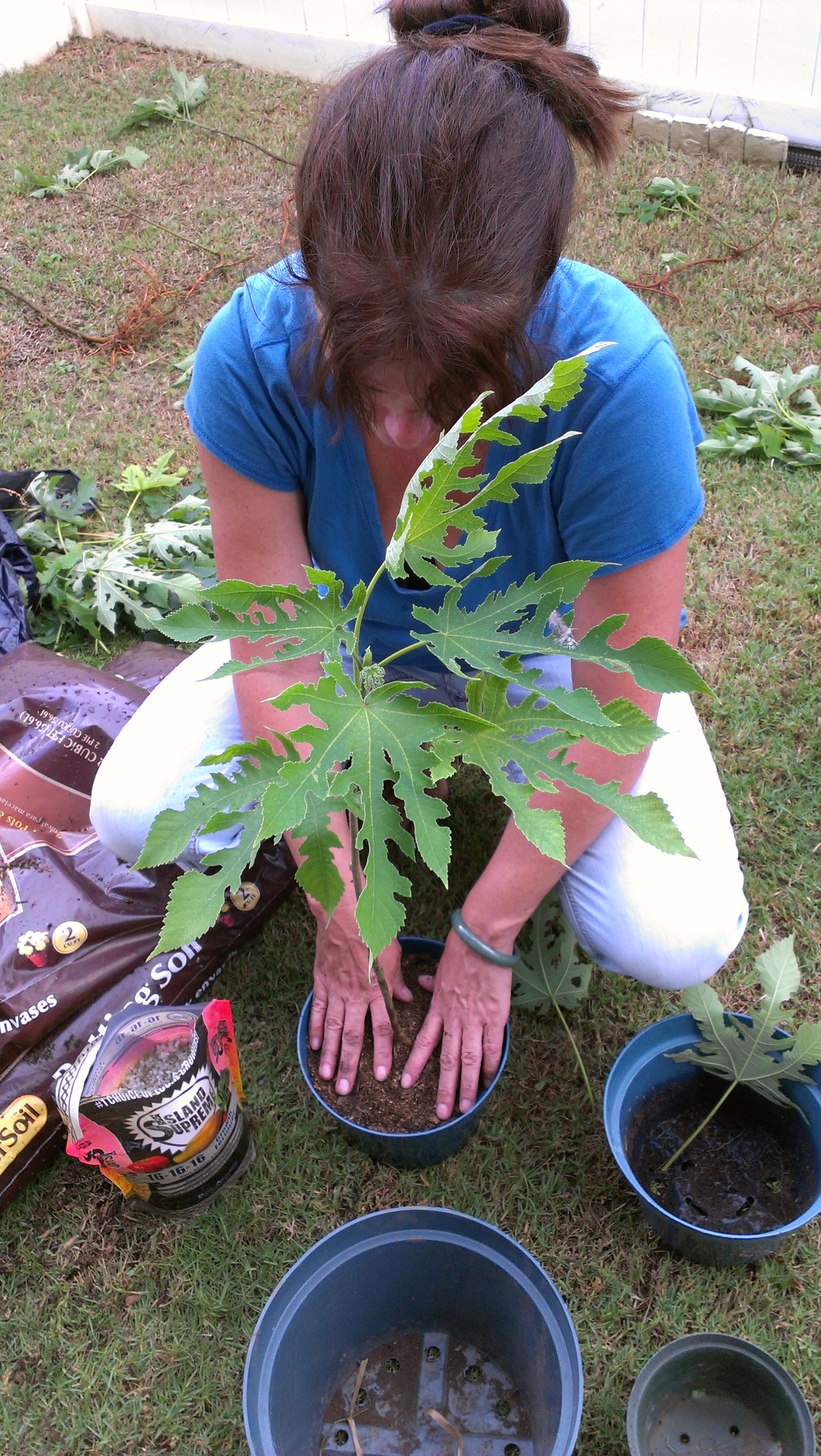
In addition to the paper mulberry tree, the inner bark of other plants is also known to be used for the bark cloth in Polynesia. Usually, the breadfruit (Artocarpus) tree, and some species of the banyan (Ficus) are used, but they produce a heavier, coarser cloth. Only the paper mulberry was cultivated and harvested especially for the purpose of making bark cloth. The paper mulberry tree cannot be grown from seeds because it does not flower. So the plant is grown by propagating from cuttings. The paper mulberry tree needs plenty of water to grow so that some South Pacific islands were not able to to grow it and either resorted to using another tree bark, or traded with neighboring islands who grew it in large amounts. Another variety of mulberry is used in the making of silk. The silkworm digests the leaves and then secretes silk fibers in a cocoon, which are later woven into cloth.

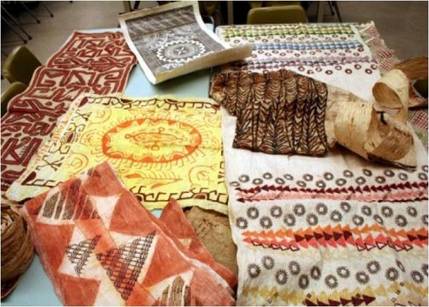
kapa assortment

“The Tapa”

The Tapa
From my father’s side I am 100% Polish. On my mother’s side I am mostly Hawaiian-Portuguese. At this time in my life I am drawn to exploring my mother’s family, and my Hawaiian heritage that is part of this genealogy. These roots were nourished while I grew, through stories, visits to the land, food, relationships with my grandparents and aunties, uncles, and cousins.. There were two iconic artifacts that I remember well, even while far away from the beloved land of Hawai’i. They were with us in our home in San Francisco. Firstly, a large conch shell, luminous and white… It had a rosy-pink interior, and told secrets in the sound of the sea. Secondly, a lovely piece of bark cloth, about 7 feet long by about 4 feet high…an amber-colored, textured mystery from bygone days that often captured my attention. My siblings and I called it, “the tapa.” It hung prominently on a wall, next to a gigantic, over-sized spoon and fork carved from monkey pod wood. Those utensils could be considered a third icon…a story of colonial propaganda and a very unimaginative metaphor at that. So I am going to just skip that and move on…

When I was a young keiki, all I knew about tapa was that it was made from tree bark, and that it was used for clothing and bedding in the old Hawaiian days. I didn’t have any idea about the meaning of the printed designs, or the cultural significance. This piece of tapa that belonged to our family had come from a much larger piece. It had come to us first as a gift to my grandfather, from a Samoan friend of his. I don’t know how big it was originally, because my grandfather in turn had cut it into portions and given smaller pieces to his daughters and sons. My mother gave me her piece eventually. I have had it about 20 years now. Since it has been with me, I learned that this tapa that I have admired and treasured for most of my life, is Tongan. In its light golden brown and sepia tones the design is a print of hermit crabs, crescents, flowers, and wreaths spatially arranged with words written in Tongan. The words say:

“KO TONGA MOUNGA KI HE LOTO” “THE TONGA MOUNTAIN WITH HEART”

In some island cultures of Polynesia, making tapa has become extinct because over the last 300 years, everyday products and personal articles that were once made from it, have been replaced by western-style goods. On the other hand, there are island groups who have never stopped their traditional uses of tapa and these countries continue in its manufacture. In Hawai’i, where language and arts are being recovered there are some cultural practitioners who are once again beating out the bark of the wauke plant, otherwise known as the paper mulberry tree (Broussonetia papyrifera). Beating this plant or others similar to it produce tapa, or kapa as it is called in Hawaiian. Island cultures of Tonga, Samoa, and Fiji have managed to continue producing tapa even in the midst of colonization and cultural disruption. It is from these southern Polynesian nations that much of the traditional knowledge is gleaned to make Hawaiian kapa. The practice of both traditional and contemporary designs and techniques was passed down through the generations and is coming alive again in its vibrant legacy.

Post Navigation