kapa kulture
This blog is dedicated to Hawaiian kapa and matters related to Hawai'i nei…kuku kapa e!

Archive for the tag “hawaiian arts”
Hawaiian Word of the Day: ʻumeke
ʻumeke: Bowl, calabash, circular vessel, as of wood or gourd. ʻUmeke kāʻeo, a well-filled calabash [a well-filled mind]. ʻUmeke pala ʻole, calabash without a dab [empty bowl, empty mind]. hoʻo.ʻumeke, hōʻumeke. To assume the shape of a bowl; to assume the shape of fruit, to bear fruit. Fig., to have enough to eat. E pua ana ka ʻōhiʻa ʻai a hōʻumeke i ka malama o Hinaiaʻeleʻele, the mountain apple blooms and fruits form in the month of Hinaiaʻeleʻele.
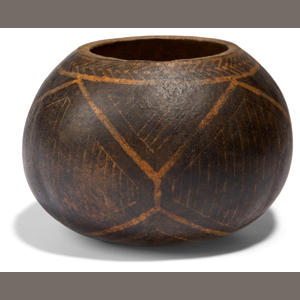
ʻumeke ʻai: Poi bowl. Fig., source of food, of the uplands.
ʻumeke ipu kai: Bowl, as for serving meat or salty meat.
ʻumeke kepekepe: Bowl with horizontal flat panels. Lit., wedged bowl.
ʻumeke lāʻau: Wooden bowl.
ʻumeke mānaʻai: Very small bowl, as formerly used for poi by favorite children. Lit., poi mouth-fed bowl.
ʻumeke ʻōpaka: Bowl with vertical panels with vertical edges between them.
ʻumeke palapaʻa: Thick-bottomed wooden calabash. Lit., firm-dabbed bowl, perhaps so called because dabs of poi are held firm in this type of calabash that does not upset.
ʻumeke pāwehe: A decorated gourd bowl, as made on Niʻihau.
ʻumeke pōhue: Gourd calabash.
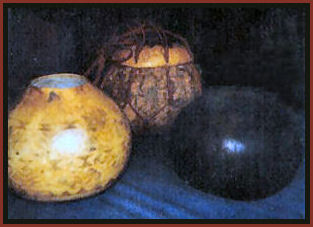
Photo found on the Kaʻahele Hawaiʻi Website. Click below to access more information on Hawaiian ipu and more resources for Hawaiian culture and arts.
Kapa that I made over the past weeks…
This photo shows 14 pieces of kapa in a variety of sizes and textures. Some are heavy and stiff, some are thin, fine, and flexible. Many hours were spent pounding these using the hohoa and iʻe kuku to form a smooth cloth from the raw wauke tree bark, paper mulberry tree. These pieces are now ready for ho’owehi, decoration. The ʻohe kāpala are literally bamboo stamps, carved to be printing tools. I have gathered raw materials to make hoʻowaiulu, dyes. I have ʻōlena root for yellow, kukui nut ashes for black, and ʻalaea a mineral in the soil for red. I also have boiled down banana flower petals and got a brown wash. Stay tuned for the results! ~Aloha~
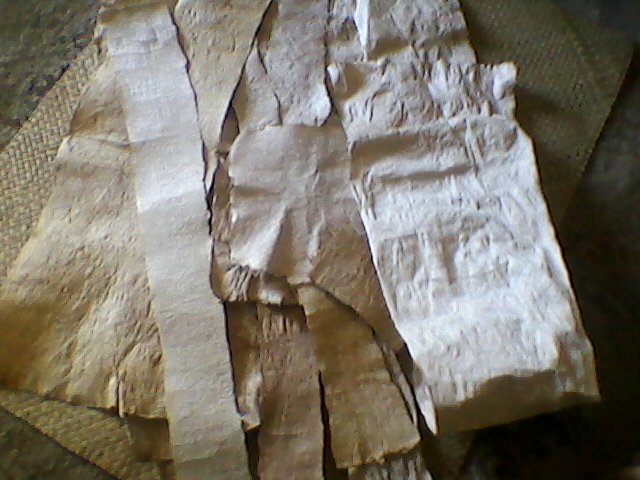
white kapa
kapa ke’ʻokeʻo
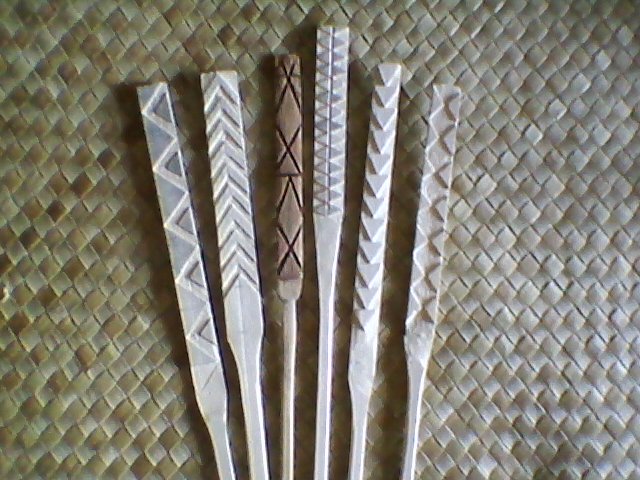
ʻohe kāpala, bamboo stamps
Hawaiian Word of the Day: ho’oki
ho’ōki: To put an end to, terminate, conclude, annul, to finish, stop; end.
Proto-Polynesian: oti.
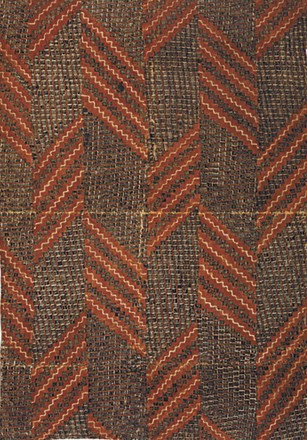
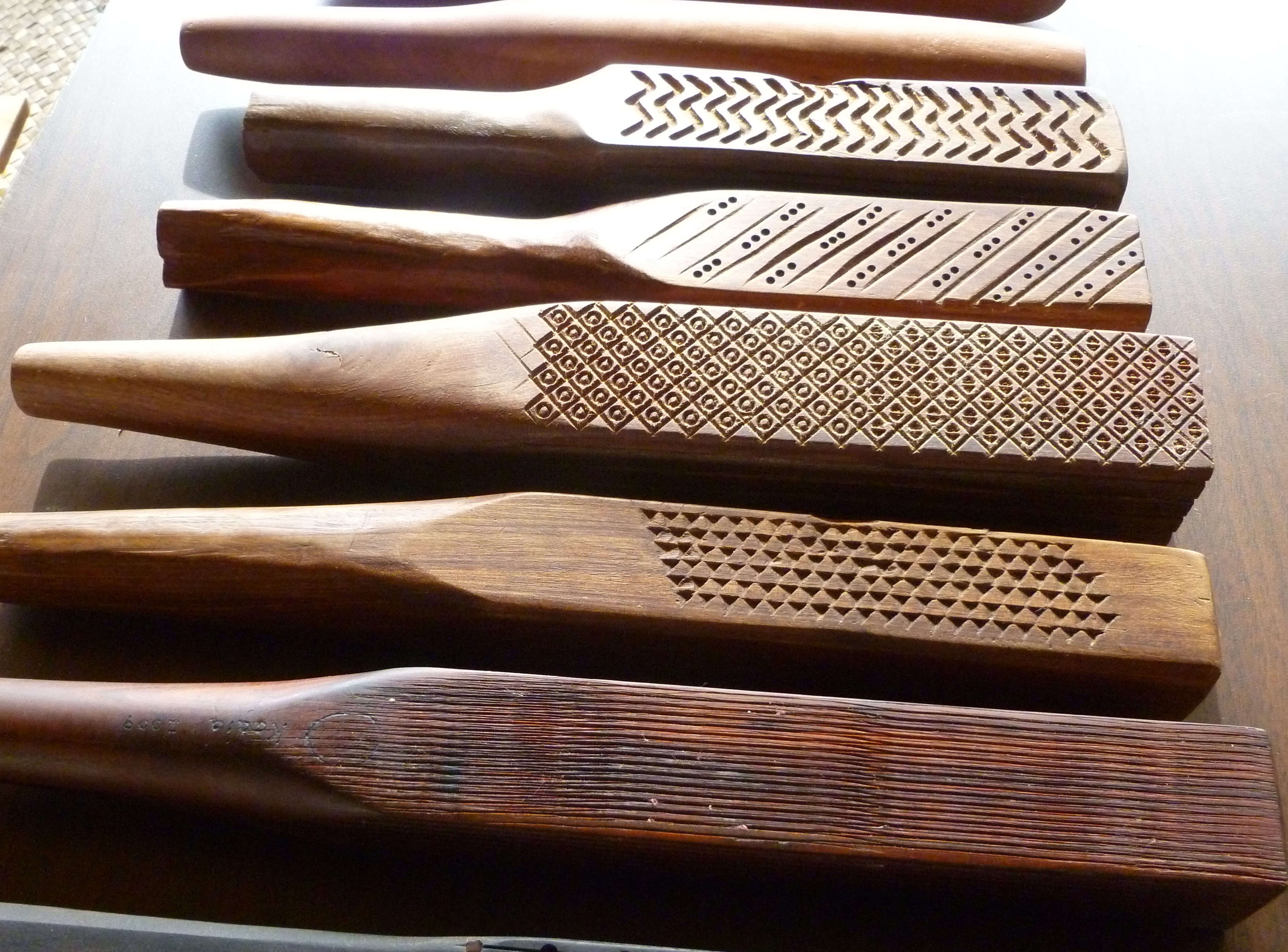
Stages of kapa-beating includes the final stage of ho’ōki, which requires using an i’e kuku ho’ōki with a watermark such as an ‘upena hālua niho mano, shark tooth with fishnet design.
“The Tapa” History and Process, Part 3
Throughout the South Pacific islands, each island nation has its own particular nuances in making tapa cloth, which distinguishes it from another. Traditional techniques were passed down and were a life skill in the community. Making tapa cloth was done primarily by women. It is a women’s art that has changed only slightly since ancient times.
Generally speaking, in Western Polynesia a piece of tapa was produced by pasting sheets together in layers and then joining smaller pieces by pasting to make a larger cloth. A heavy, coarse material results from this method. Whereas in Eastern Polynesia a felting process was done, pounding pieces into a single layer, without a fusing agent, or paste. Gradually a large piece of cloth is built up using this felting process. And a softer product is the result.
The tapa cloth in Polynesia begins with a basic process of removing the inner bark, or bast, from the trees and soaking this inner part in water for several days to soften and ferment the fibers and get them ready for pounding into thin sheets. The paper mulberry trees (wauke) are grown for this purpose and carefully cultivated. They are allowed to grow six to eight feet high until one to two inches in diameter. The trees are constantly cared for and tended while they grow. Young branches are broken off to ensure consistent, straight fibers to make smooth, whole tapa sheets unmarred by holes.
Special tools are used in the fabrication of tapa cloth. A type of anvil, a wooden block usually, is a sort of table that the bark is placed on and from start to finish, the tapa is pounded, or beaten. Techniques involve special shells used like knives to strip off the outer bark lengthwise from the tree, and to remove the bast. A selection of carved, wooden beaters flattens and spreads the fibers. Starting with a rounded club, moving to a grooved style that has four parallel sides, serving as steps toward finishing a smooth final product.
Additionally, Hawaiian tapa, or kapa cloth has a final step of beating, which leaves a watermark imprint on the cloth. This watermark is a unique carved design on a beater that served as the artist’s signature and finished the work in an important part of the felting process.
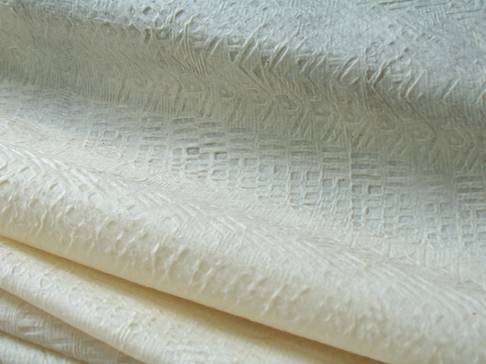
Kapa with watermark, made by Dalani Tanahy
Hawaiian Word of the Day: kua
kua: 1. Back, rear, burden, windward; to carry on the back, as a child. 2. To hew, chop,chip, hack, dub, strike, cut out; to fell, strike down, as an image; anvil, as of a blacksmith or for beating tapa; house used for beating tapa. 3. Beam, rafter. 4. Yoke of a dress; back of a garment; ox yoke. 5. Poles used in quilt making; the three unsewn quilt layers are placed on one another with the kua, poles, rolled into each end; the entirety is set over wooden horses and is stretched taut, so that the sewer may sew the layers together. 6. Variation of akua, god, image, especially after -a. 7. Midrib, as of pandanus leaf. 8. Third brew from kava. (Pukui & Elbert, 1971).

 kapa kulture