kapa kulture
This blog is dedicated to Hawaiian kapa and matters related to Hawai'i nei…kuku kapa e!

Archive for the tag “cultural arts”
Walaʻau–talking story
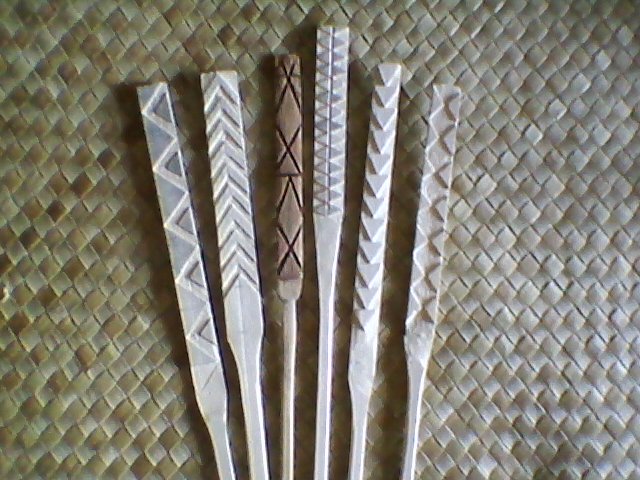
I spent my day yesterday playing around with some natural dyes I’ve collected, and dye mediums. I practiced printing designs with my ʻohe kāpala (bamboo stamps). This is one of my practice pieces done on watercolor paper with kukui nut ashes (grey) and ʻalaea (red).

kapa wehi
I used kukui nut oil mixed with water as the medium for the ‘alaea. It made a good consistency that enabled the pigment to be both dark enough and fluid enough for printing. The kukui ash did not work well with oil and/or water. I ended up using it dry and applied it using a small piece of kapa as a brush. This method of “dry painting” with a tapa brush was noted by Te Rangi Hiroa (Peter H. Buck) who was a director at the Bishop Museum from 1936 until he died in 1951. Among his many achievements, Buck wrote a series of scholarly publications entitled “Arts and Crafts of Hawaii” (1964) in which he wrote on various subjects of Hawaiian cultural life. Clothing, was one of the sections and it includes a pretty thorough discussion of Hawaiian kapa history, tools, and processes. Some other sections in the Arts and Crafts of Hawai’i series are food, houses, canoes, fishing religion, war and weapons, death and burial, and more.
Kapa that I made over the past weeks…
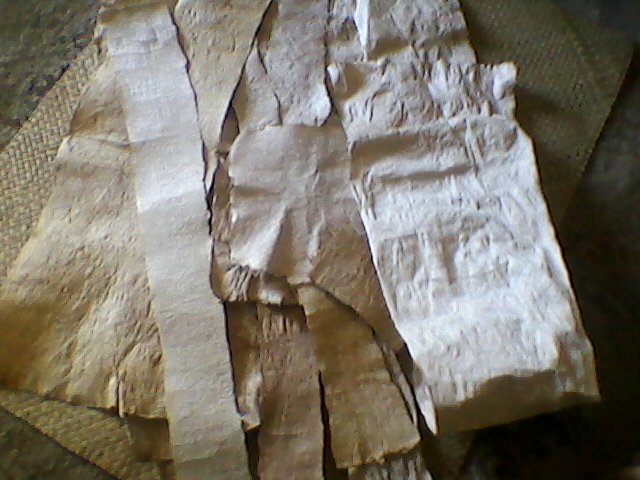
This photo shows 14 pieces of kapa in a variety of sizes and textures. Some are heavy and stiff, some are thin, fine, and flexible. Many hours were spent pounding these using the hohoa and iʻe kuku to form a smooth cloth from the raw wauke tree bark, paper mulberry tree. These pieces are now ready for ho’owehi, decoration. The ʻohe kāpala are literally bamboo stamps, carved to be printing tools. I have gathered raw materials to make hoʻowaiulu, dyes. I have ʻōlena root for yellow, kukui nut ashes for black, and ʻalaea a mineral in the soil for red. I also have boiled down banana flower petals and got a brown wash. Stay tuned for the results! ~Aloha~
white kapa
kapa ke’ʻokeʻo
ʻohe kāpala, bamboo stamps

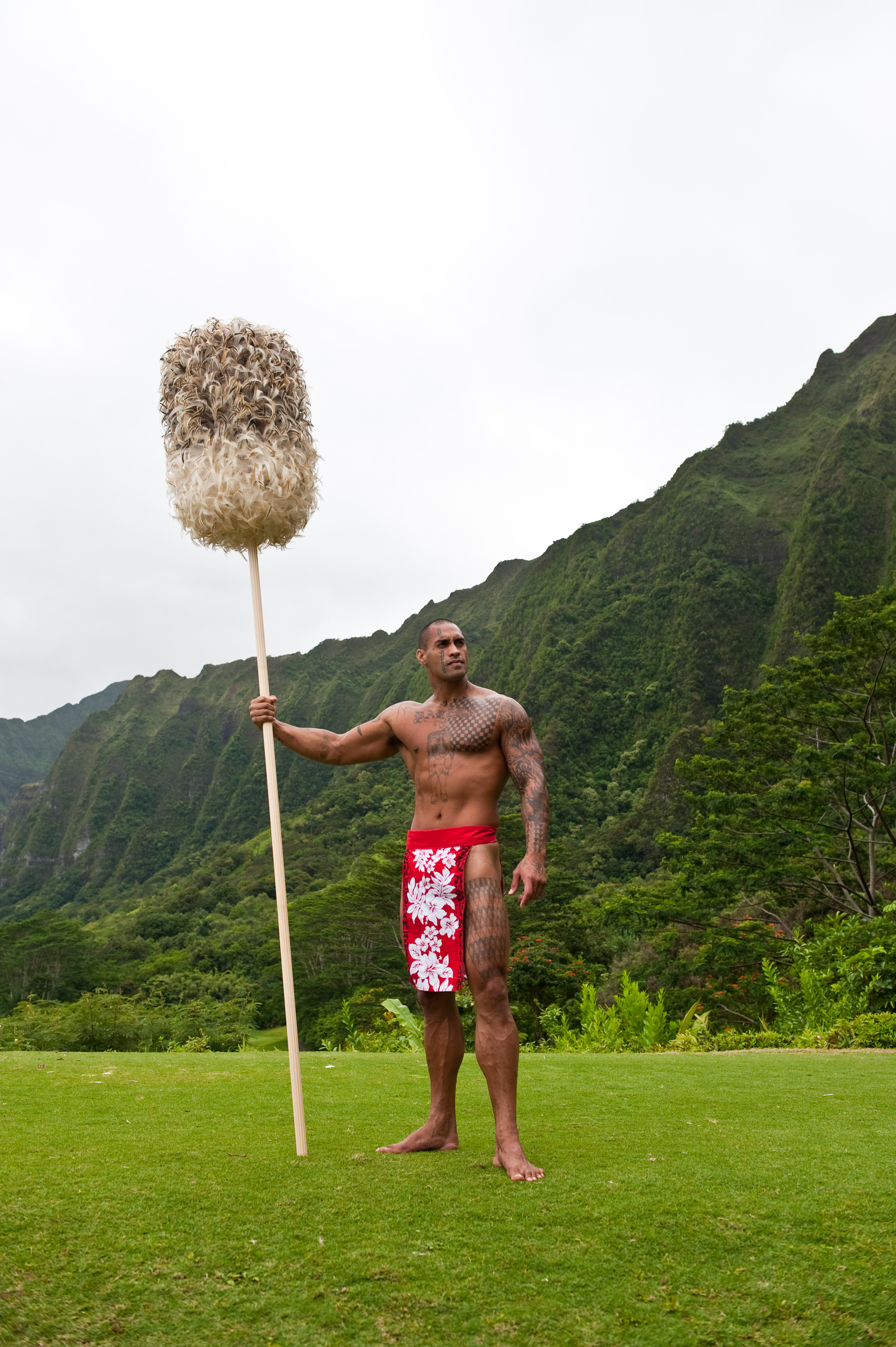
Hawaiian Word of the Day: kāhili
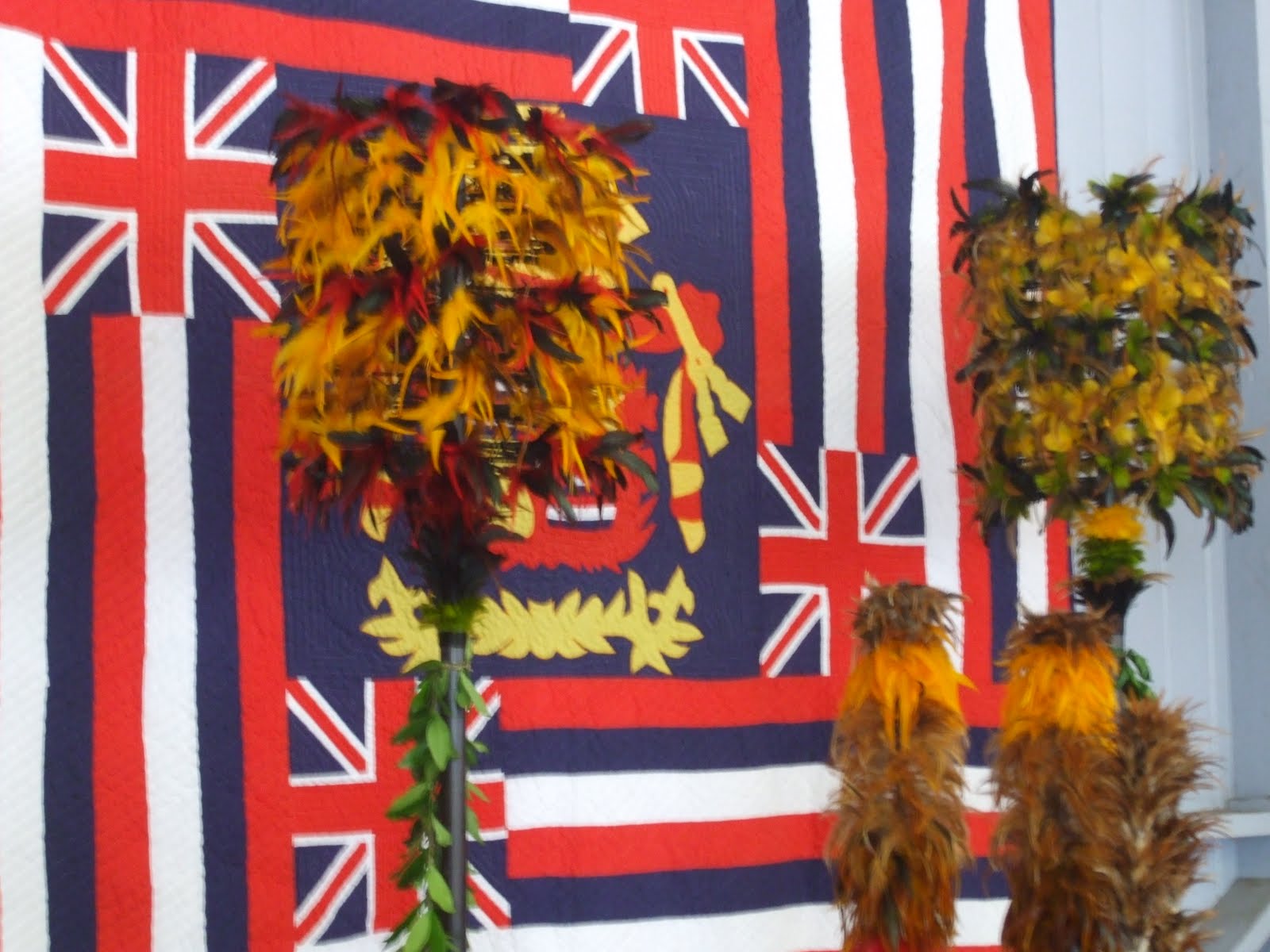
kāhili: 1. Feather standard, symbolic of royalty; segment of a rainbow standing like a shaft (also a sign of royalty); to brush, sweep, switch (to spray, as in kāhilihili: Kāhilihili ke kai a ka he’e nalu, spraying sea of surf-rider).
Kāhili chants (As in ‘ou’ou, to describe the pinnacle or high peak): I ka lālā wēkiu ka pua o Lono, i ka ‘ou’ou o nā lani nui, in the topmost branch the flowers of Lono, among the highest of the high chiefs.
2. Pa’a kāhili, kāhili bearer. Kū kāhili, one standing by a kāhili or carrying it. Kāhili pulu, to clear away mulch. Haku ‘ia na’e ho’i ka hulu o ka moa i kāhili i mua o nā ali’i; kāhili ‘ia na’e ho’i kō kua, chicken feathers indeed are woven into a standard for the presence of the chiefs; your back is brushed by the kāhili.
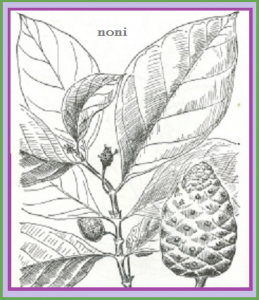
ho’okāhili. To brush or fan gently. 2. The crape myrtle (Lagerstroemea indica), an ornamental shrub from China, with small oval leaves and panicles of pink, white, or purple crape flowers. 3. A small tree (Grevillea banksii) from Australia, related to the silky oak, ‘oka kilika, but the leaves with fewer subdivisions and the flowers red or cream-white. This is a later application of kāhili to a plant. Flowers not used for leis on head or around neck because of irritating hairs, but made into leis for hats by sewing alternated rows of flower clusters and own leaves on pandanus band. 4. Kāhili ginger (Hedychium gardnerianum), from the Himalaya region; much like the white ginger but with a more open flower head, the flowers with narrow yellow segments and one bright red stamen apiece. Also ‘awapuhi kāhili. 5. A seaweed, probably Turbinaria ornata.


Kapa Māna’o…(knowledge)
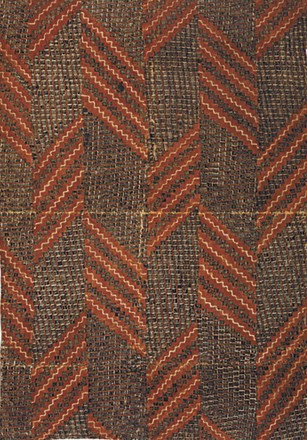
I had a long conversation the other night with my new friend and kapa maker extraordinaire, Dalani Tanahy www.kapahawaii.com. We hit on topics up, down, and sideways…but guided by a set of questions I held in my hand. The purpose of the call was to understand her point of view related to things of “kapa kulture.” Some of the Q’s were theoretical, political, or cultural in nature. But the practical, …oh, the practical… how wonderful to get the scoop from such a dedicated kapa master! Her wisdom and expertise inspired me to revisit several pieces of my own recently pounded kapa which I felt to be under par. I was unsatisfied with the look and feel of these pieces. I had underestimated the work involved and the previous 10 or more hours was not yet sufficient time spent to pound the wauke fibers into soft and flat submission. The result was striated sheets which were stiff and cardboard-like rather than the papery softness I was aiming for. If it was to be worn as a malo or pā’u garment, scratchy and uncomfortable to wear indeed!
Back to my kua I went, taking my kapa with me… I wet the dried sheet with sprays of misty water. After careful pounding for a couple of hours, I managed to produce a softer, whiter, and more delicate specimen that was getting closer to the ideal proposed by Hawaiian historian, Samuel Kamakau, who had declared that the “well-made tapa must be clearer than the light of the moon, whiter than the snow upon the mountains.” Kapa making is not for the faint of heart or impatient, but as an art it requires careful labor and the time to coax a smooth and graceful hand from coarse, raw material.

Hawaiian Word of the Day: lawa
lawa: 1. Enough, sufficient, ample; to have enough, be satisfied. Lawa pono, plenty, abundant, ample, adequate. Lawa pono ‘ole, insufficient, deficit. Ka’a i ka lawa, to be enough. ho’olawa. To supply, apportion sufficiently, equip. E ho’olawa mai ‘oe i lau hala e pa’a ai keīa moena, supply me enough pandanus leaves to finish this mat. 2. Possessed of enough or ample knowledge, hence wise, capable, competent. Ua lawa ke ‘ike, knowing a great deal. Ua lawa i ka hānai keiki, wise in raising children. 3. As soon as, I lawa nō ā pau ka hana ho’i kāua, as soon as the work is finished, we’ll leave. 4. Strong, husky; strong man, as in a king’s retinue, lawakua. 5. To bind, make fast, tie securely. 6. White, as of a cock or dog. Moa lawa, moa lawa kea, white cock. 7. A large shark fishhook.
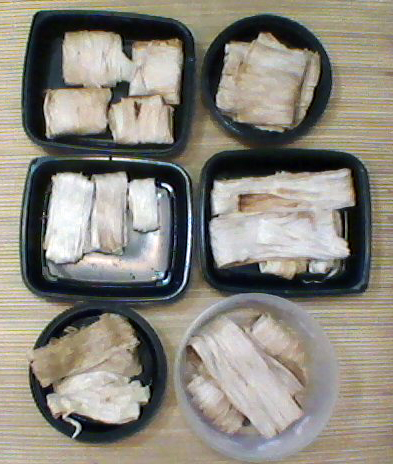
lawa pono wauke i ho’omo’omo’o
Hawaiian Word of the Day: lauhuki
lauhuki: 1. Tapa-soaking, to soak tapa. 2. (Cap.) Name of a goddess worshiped by tapa makers.

lauhuki
 kapa kulture