Hawaiian Word of the Day: ‘u’u
‘u’u: To strip, as leaves or maile bark; to draw in, as a line on a ship; to draw out, unsheath, as a sword…(Pukui & Elbert, 1971).

‘u’u ka i’o o loko, strip the inner bark

‘u’u: To strip, as leaves or maile bark; to draw in, as a line on a ship; to draw out, unsheath, as a sword…(Pukui & Elbert, 1971).
‘u’u ka i’o o loko, strip the inner bark
haumana:: 1. Student, pupil. apprentice, recruit, disciple. 2.Technological student, trainee, apprentice. Haumana komo hou, new student, freshman. ho’ohaumana: to act as a pupil, become a pupil; to make pupils of.

punana: 1. Nest, gathering place, shelter, hive; to nest. Fig., home. Punana ka manu i Haili, the bird nests at Haili. E make auane’i au i loko o ku’u punana, I shall die within my nest. He aikane, he punana na ke onaona, a friend is a nest of fragrance. ho’o.punana. To make a nest, to settle in a nest or over young; to sit on eggs, as a hen; to take shelter. Ho’opunana ka mana’o, to set the mind on, plan, focus attention on. 2. A variety of sweet potato. 3. A process of making women’s pa’u; white tapa. (Pukui & Elbert, 1971).

(Ka Hana Kapa O Leilehua Yuen)
wai: Water, liquid or liquor of any kind other than sea water, juice, sap, honey, liquids discharged from the body, as blood, semen; color, dye, pattern; to flow, like water, fluid. 2. (Cap.) Place names beginning with Wai-, river, stream. 3. Grain in stone. 4. To retain, place, leave, remain, earn, deposit. 5. (also spelled ai.) interrogative pronoun. Who, whom, whose, what. 6. Type of house with thatch purlins separated by a width of two fingers.

mo’omo’o: 1. Same as mo’o (a small fragment, as of tapa, not attached to a large piece). Strips of wauke bast beaten together from which tapa sheets are to be made. ho’o.mo’omo’o. to beat raw bast into mo’omo’o. 2. Ridges, as of mountains, 3. Young of animals. (Pukui & Elbert, 1971).
A bundle of mo’omo’o is termed a poho.

“Before the dry mo’omo’o strips could be beaten into cloth they had to be soaked in water until they were soft They were then beaten lightly to break up the fibers. The number of strips necessary to complete a cloth was rolled into bundles termed poho by Kamakau, who then states that five poho would make five tapas and 10 poho would make 10 tapas. He also says that five strips would make a woman’s skirt (pa’u), so the number of strips in a bundle depended on the size of tapa desired. When enough bundles were prepared, some banana leaves were spread out in a shady part of the yard and bundles placed upon them. Then they were covered with more banana leaves, and stones were placed over them to weight down the corner. Kamakau says that the stone-covered heap resembled the mound of an earth oven. They were left for a week or a week and a half to maturate, until the bast was smooth and ready to undergo the second beating process” (Buck, p.181, 1987) (Hiroa, Te Rangi -Buck, P.H.- (1957, 1964, 1987). Arts and Crafts of Hawai’i, No. 5, Clothing. Bishop Museum Press: Honolulu).
hohoa/hoahoa: To strike with a stick or club; to club; a club; a rounded tapa beater (also called pepehi); rapid beating, striking, as of tapa or pandanus leaves; a stick beater for washing clothes. Fig., bad-tempered, Keu ho’o keia a ke kanaka hoahoa, this person certainly beats the beater [in rage]. ho’o.hoa.hoa. (Pukui & Elbert, 1971)
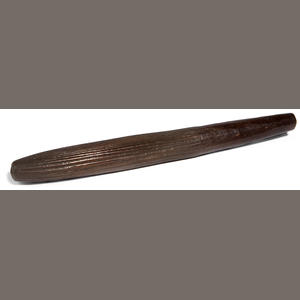
kua: 1. Back, rear, burden, windward; to carry on the back, as a child. 2. To hew, chop,chip, hack, dub, strike, cut out; to fell, strike down, as an image; anvil, as of a blacksmith or for beating tapa; house used for beating tapa. 3. Beam, rafter. 4. Yoke of a dress; back of a garment; ox yoke. 5. Poles used in quilt making; the three unsewn quilt layers are placed on one another with the kua, poles, rolled into each end; the entirety is set over wooden horses and is stretched taut, so that the sewer may sew the layers together. 6. Variation of akua, god, image, especially after -a. 7. Midrib, as of pandanus leaf. 8. Third brew from kava. (Pukui & Elbert, 1971).

ahu: Heap, pile, collection, mound, mass; altar, shrine, cairn; a traplike stone enclosure made by fishermen for fish to enter; laid, as the earth oven. Cf. ahu waiwai, ahuwale, O’ahu. ahu kele, mud heap; muddy. Ahu ka pala! A heap of excreta [hence worthless; sometimes shortened to ahu only or to e ahu ana]! Ahu ka ‘ala’ala! A heap of squid ink! Not worth much! Ahu wawa, a great din. Ahu ili, a large inheritance or transfer [said of reward, vengeance]. Ahu ‘ena’ena, a red hot heap [an oven]. Ahu kupanaha ia Hawai’i ‘imi loa, a mass of wonderous things in deep delving Hawai’i. ho.’ahu. To pile, gather, accumulate, heap up; to lay away, as goods for the future; collect; collection, mound. Fig., to resent, dislike, Hale ho’ahu, storehouse, warehouse. Lumi ho’ahu, storeroom. E ho’ahu ana i ka huhu maluna o kela po’e, heaping up anger against those people. (Pukui & Elbert, 1971)
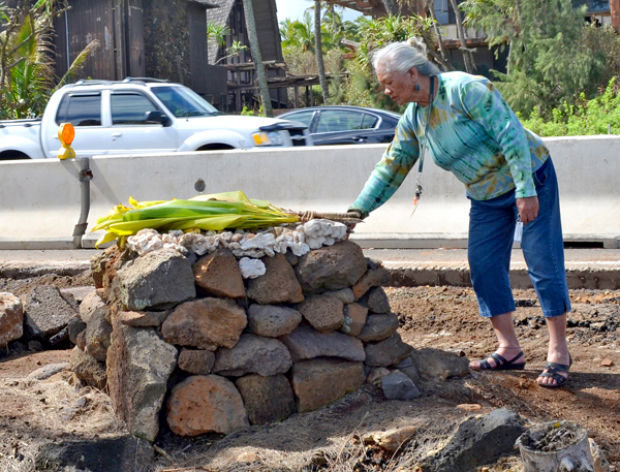
Aunty Puanani Rogers replaces a piece of coral at the kuahu, at the Mahunapu’uone Heiau at Wailua Beach February 2012
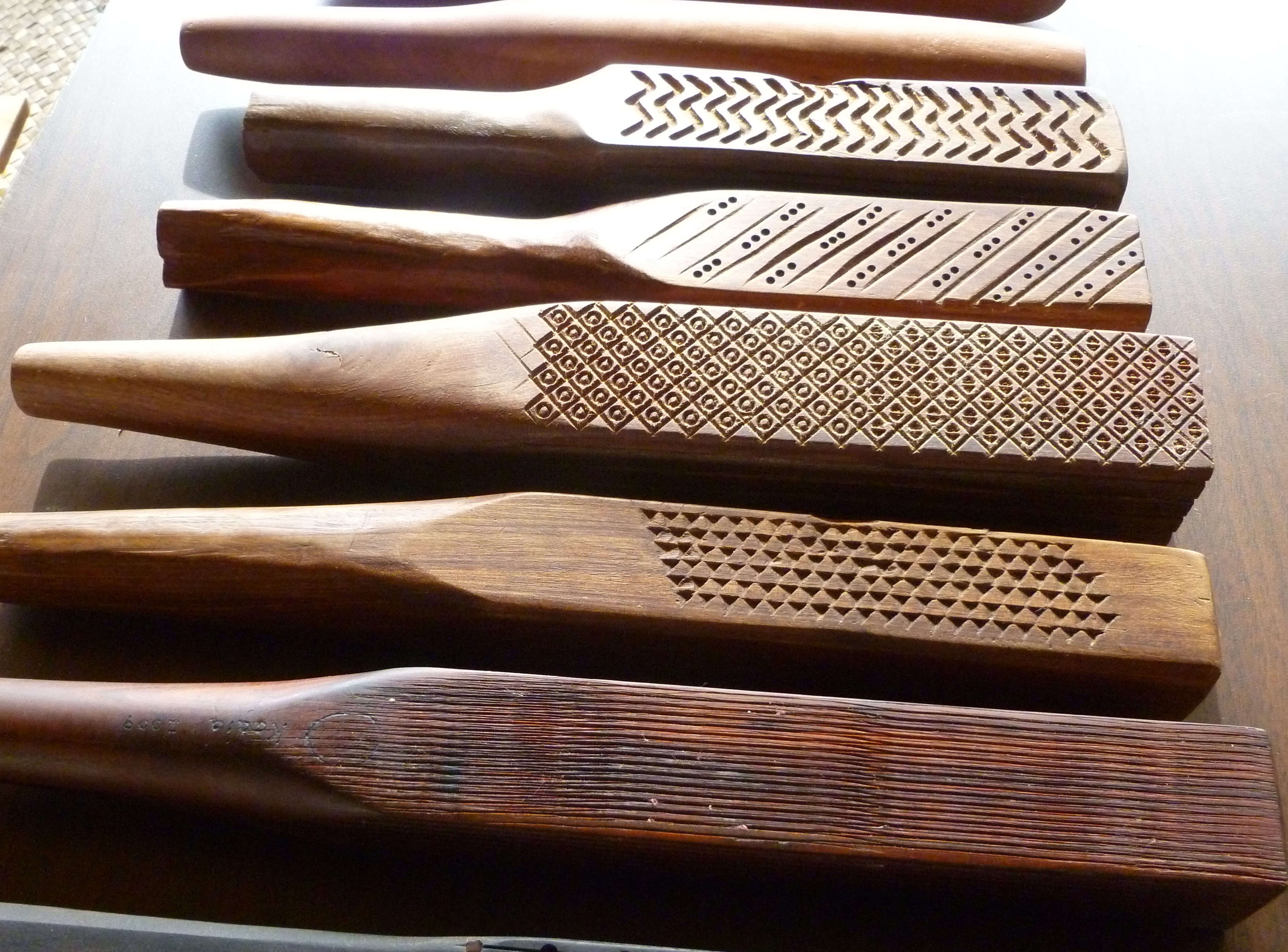
i’e kuku: Tapa beater. i’e kuku ho’oki: Tapa beater, as used to finish the tapa. Lit. finishing-beating mallet.

